
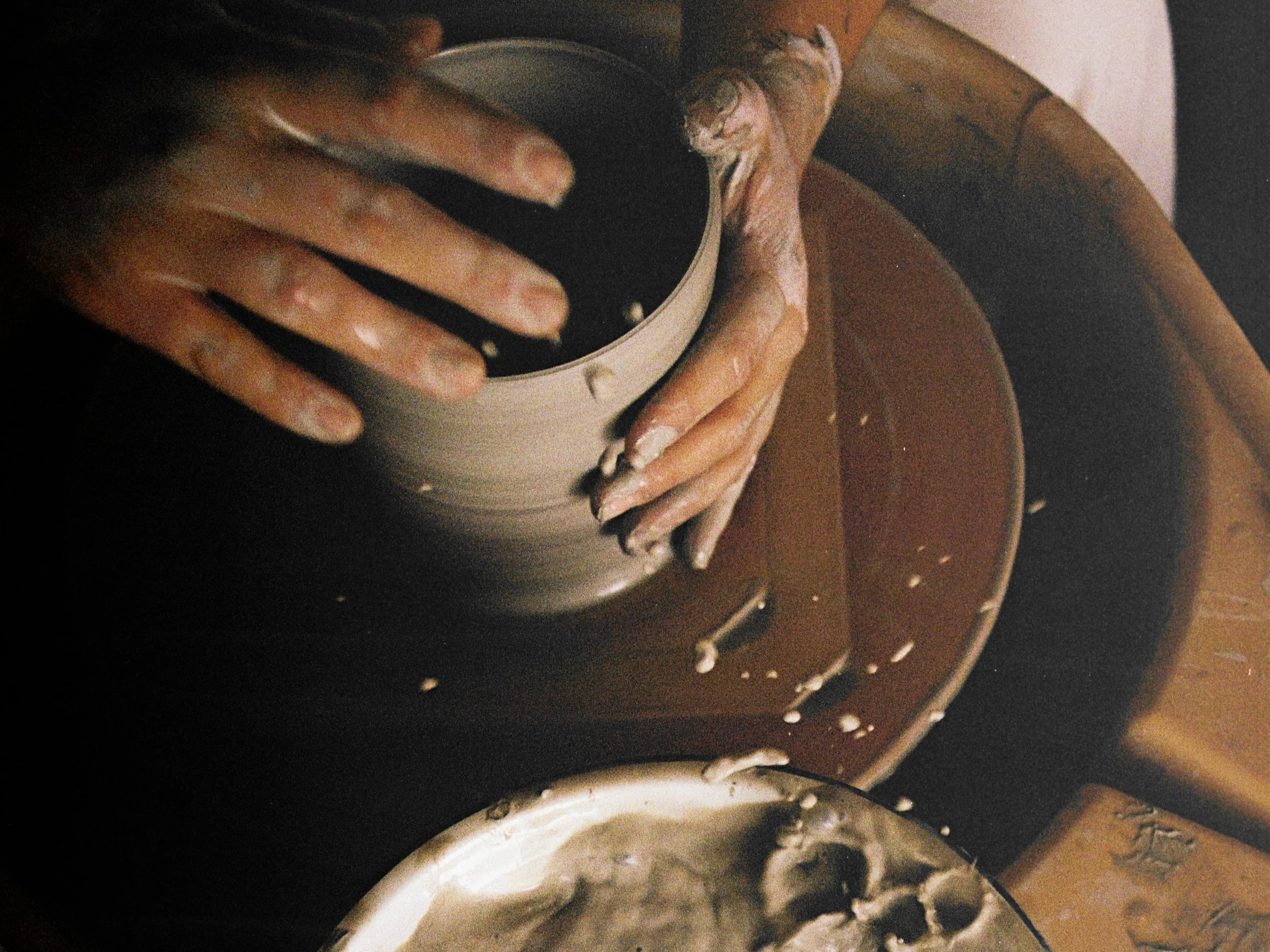
Step-by-step pottery guide: how to start your first ceramic piece
Ever wondered what actually happens during a pottery workshop or ceramic class?
Ever watched someone working on a pottery wheel and thought: how do they make that look so easy?
Spinning clay, steady hands, perfect shapes… it almost looks hypnotic.
But here’s the truth: your first time on the wheel during a pottery workshop or ceramic class won’t be perfect — and that’s exactly what makes it so fun.
In this step-by-step guide, you’ll discover how a pottery class on the wheel actually works. So whether you're preparing for your first ceramic workshop or just curious about the process, this will give you a clear and honest look behind the scenes.
Step 1: Preparing and centering the clay
Everything on the wheel starts with one crucial step: centering.
You place a lump of clay on the spinning wheel… and immediately realize something:
The wheel doesn’t adapt to you.
You have to adapt to the wheel.
Centering means forcing the clay into a perfectly balanced position while it spins. This is done by applying steady pressure with both hands.
At first, it feels tricky. The clay moves, wobbles, resists.
But once it clicks, you feel it instantly.
This is the foundation of every pottery class on the wheel — and the moment most beginners go from confused to fully focused.
Step 2: Opening the clay
Once your clay is centered, you create space inside it.
Using your thumbs, you slowly press into the middle while the wheel spins. This forms the base of your cup or bowl.
It’s a delicate balance:
Too much pressure → you go through the bottom
Too little → nothing happens
During a ceramic class, this is where guidance really helps. A small adjustment in hand position can make a huge difference.
And when it works? It feels incredibly satisfying.
Step 3: Pulling up the walls
Now comes the step that looks the most impressive: pulling.
You place your fingers inside and outside the clay and gently pull upwards while the wheel spins.
This is how your piece gets height.
It’s also where beginners quickly learn:
Pottery is about control, not force.
If you rush, the walls collapse.
If you stay steady, the shape starts to form.
In a pottery workshop, this is often the moment where everything clicks — when a simple lump of clay becomes something recognizable.
Step 4: Shaping your piece on the wheel
Once you have height, you start shaping.
This is where creativity comes in.
You can turn your piece into:
A cup
A bowl
Something slightly wobbly but uniquely yours
During a ceramic workshop, you’ll learn how to guide the shape using subtle pressure and positioning.
This step isn’t about perfection.
It’s about discovering what happens when you let go a little and trust the process.
Step 5: Cutting and finishing your piece
When your piece is ready, it’s time to remove it from the wheel.
Using a thin wire, you carefully cut it loose from the base.
This moment feels small — but it’s big.
Because for the first time, you’re holding something you made from scratch.
After your pottery class, your piece will need time to dry before it goes into the kiln.
Step 6: Drying, firing and glazing
Just like with any ceramic class, the process doesn’t end when the wheel stops spinning.
Your piece goes through several final stages:
Drying completely
First firing in the kiln
Glazing (adding color and finish)
Second firing
This transforms your soft clay into a finished ceramic object.
And this is where your work truly comes to life.
Why wheel pottery is such a unique experience
There’s something different about working on a wheel.
It demands your attention.
It forces you to slow down.
And it rewards patience.
A pottery workshop on the wheel is not just creative. It’s almost meditative.
You can’t rush it. You can’t multitask.
You’re fully in the moment.
And that’s rare.
From watching to doing
Reading about wheel pottery gives you an idea.
But feeling the spinning clay under your hands?
That’s something else.
Joining a ceramic workshop or pottery workshop is the fastest way to understand it.
And once you try it, you’ll see why so many people get hooked after just one ceramic class.
FAQ about pottery wheel classes
Is a pottery wheel class suitable for beginners?
Yes, most classes are designed specifically for first-timers.
Is it harder than hand-building?
A bit, but also more rewarding. And you’ll be guided step by step.
How long does it take to learn wheel pottery?
You can create your first piece in one session, but mastery takes time.
What if my piece fails?
That’s part of the experience, and often the most fun part. ;)
Final thought
A pottery wheel looks intimidating from the outside.
But once you sit down and start, something shifts.
The noise fades.
Your focus sharpens.
And suddenly, it’s just you and the clay.
So whether you're planning to join a pottery class, a ceramic class, or a full pottery workshop — this is where it begins.